If pain along the outside of your knee suddenly forces you to cut a workout short, you’re not alone.
Many runners, cyclists, and active adults experience this type of discomfort at some point — especially during repetitive activities like running or climbing hills.
What starts as a mild irritation can quickly turn into sharp pain that makes exercise difficult to continue.
One common cause of this type of knee pain is IT band syndrome, a condition caused by irritation of the iliotibial band along the outside of the leg.
It’s especially common among runners and athletes, which is why it’s often grouped into conversations about “runner’s knee” and other overuse injuries.
If repetitive training is starting to catch up with you, our article on reducing sports injuries through physical therapy also offers helpful guidance on prevention and recovery.
The good news is that IT band syndrome is highly treatable, and physical therapy is often one of the most effective ways to reduce pain, improve movement, and safely return to activity.
In this article, we’ll take a closer look at what IT band syndrome is, why it develops, common symptoms to watch for, and how physical therapy can help you recover and prevent future flare-ups.
Let’s start by understanding what the IT band actually is and how this condition develops.
What Is IT Band Syndrome?
Iliotibial (IT) band syndrome happens when the iliotibial band becomes irritated as it repeatedly moves over structures near the outside of the hip or knee.
This irritation most often causes pain along the outside of the knee, though some people also notice discomfort higher up along the outer thigh or hip.
The IT band is a thick band of connective tissue that runs along the outside of the leg from the hip to the knee.
It helps stabilize the leg during movement, especially during repetitive activities like running, climbing, and cycling.
When the surrounding muscles are tight or weak, or when movement mechanics are off, the IT band can become overloaded.
Over time, that repeated stress may lead to inflammation, pain, and difficulty with exercise.

What Causes IT Band Syndrome?
IT band syndrome usually develops because of repetitive stress rather than one single injury.
It’s especially common in people who run, cycle, or do other activities that involve repeated bending and straightening of the knee.
You may be at higher risk if you train frequently, increase activity too quickly, run on hills or uneven surfaces, wear worn-out footwear, or have weakness or movement issues affecting the hips, knees, or ankles.
If you’re dealing with ongoing movement-related pain, you can also explore the conditions we treat to see how physical therapy can help with common knee, hip, and overuse injuries.
Other contributing factors may include training errors, poor recovery, running on sloped or uneven surfaces, worn-out footwear, lower-body alignment issues, and weakness in the hips or core.
Some people may also be more prone to IT band irritation because of the way they move or the way force travels through the leg during activity.
How To Know If You Have IT Band Syndrome
IT band syndrome often causes pain along the outside of the knee, especially during or after running, cycling, climbing stairs, or hill workouts.
Some people also notice a clicking or snapping sensation on the outside of the knee or discomfort that travels up the outer thigh or toward the hip.
Symptoms often begin as pain that shows up after activity, but as irritation builds, the pain may start earlier in a workout and become harder to ignore. In more persistent cases, discomfort can continue even after exercise has ended.
Because pain along the outside of the knee can have more than one cause, our article on physical therapy for runner’s knee can also help you understand how similar overuse-related knee problems are evaluated and treated.
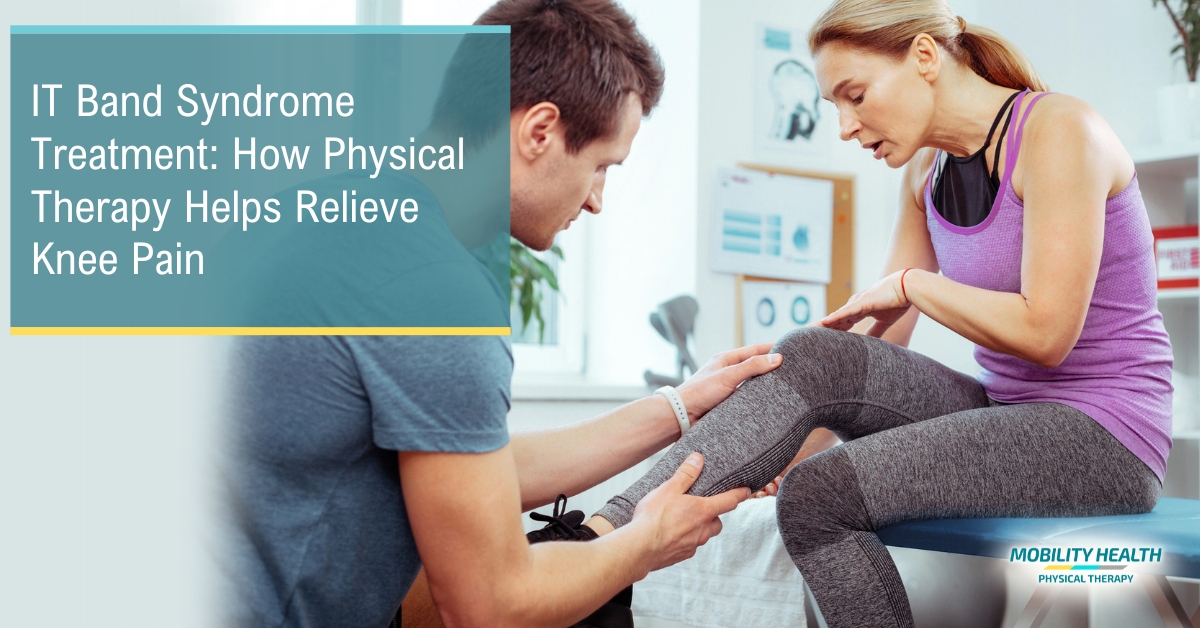
A physical therapist can often identify likely IT band syndrome by reviewing your symptoms, training history, and movement patterns, then examining how your hip, knee, and ankle move together.
They may also check for tenderness along the outside of the knee and look for strength or mobility issues that could be contributing to the problem.
Imaging is not always necessary, but it may be recommended in some cases if your symptoms are severe, persistent, or if another injury needs to be ruled out.
Is IT Band Syndrome Common?
IT band syndrome is a common overuse injury, especially in runners, cyclists, and other active adults who perform repetitive lower-body movements.
It’s one of several conditions that can contribute to lateral knee pain, which is why a proper evaluation is important before starting treatment.
If you’re comparing possible causes of ongoing knee discomfort, our article on physical therapy for knee pain relief for injuries, arthritis, and more offers a broader look at how physical therapy approaches different sources of knee pain.

How Can Physical Therapy Help IT Band Syndrome?
Physical therapy for IT band syndrome usually focuses on reducing irritation, improving mobility, and correcting the movement patterns that may be overloading the outside of the knee.
Your treatment plan may include activity modification, stretching, strengthening for the hips and legs, and guidance on how to return to running or exercise more safely.
Your physical therapist may also evaluate footwear, training habits, and lower-body mechanics to identify what’s contributing to the problem.
Depending on your needs, treatment may also include hands-on care, mobility work, and other techniques that support pain relief and recovery.
You can learn more about the broader physical therapy services we offer for injury recovery, pain relief, and performance-focused care on our services page.
Recovery timelines vary, but many people improve with a consistent plan and a gradual return to activity.
If muscle tightness and mobility restrictions are part of the problem, our article on low load stretching also explains a gentler approach to improving flexibility during recovery.
Book Your Appointment With Our Physical Therapy Clinic Today
IT band syndrome can make running, exercising, and even everyday movement uncomfortable, but the right treatment approach can help you get back to doing what you enjoy.
Physical therapy focuses on reducing irritation, improving flexibility and strength, and correcting movement patterns that may be contributing to your pain.
With a personalized treatment plan, many people are able to recover fully and safely return to their regular activities without ongoing discomfort.
Addressing symptoms early can also help prevent chronic irritation and future flare-ups.
At Mobility Health Physical Therapy, our team offers in-clinic, mobile, and online physical therapy options in New York City to support your recovery in the way that works best for your lifestyle and goals.
Book your appointment with Mobility Health Physical Therapy today and take the first step toward moving comfortably and confidently again.